

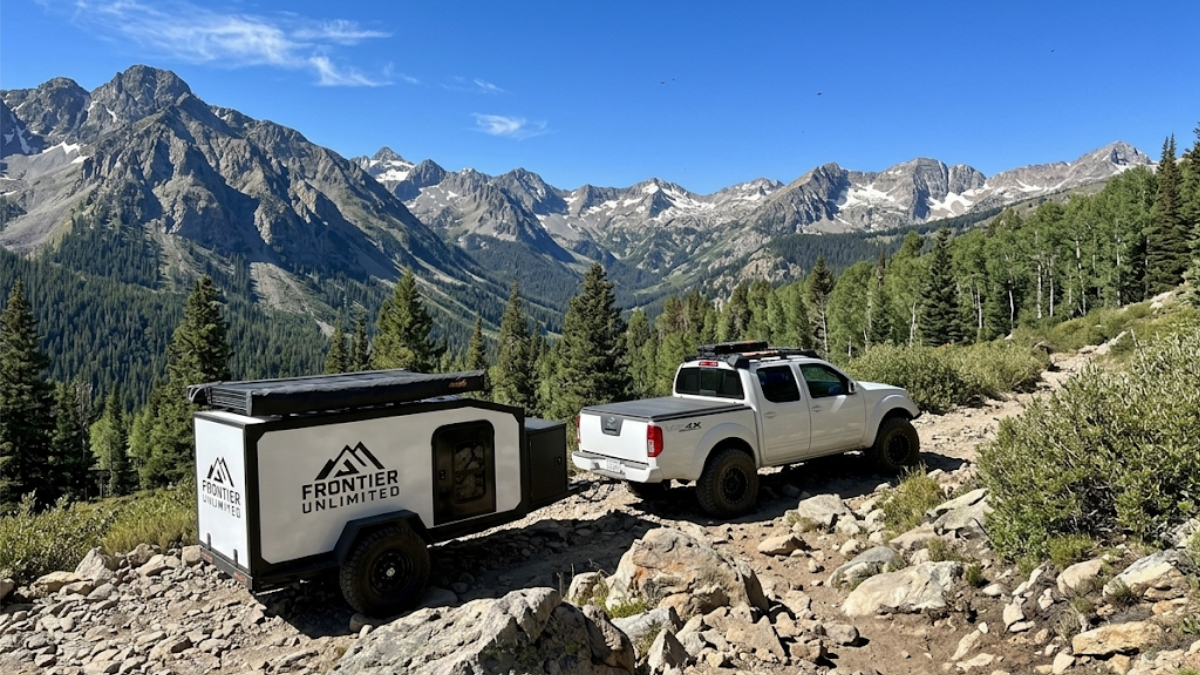
Choosing a reliable off-road camping trailer starts long before you ever leave pavement. After 100,000+ miles of full-time overland travel and four years of building, testing, and breaking things on purpose, we have some thoughts.
Table of Contents
Most off-road camping trailers are built for campgrounds with level ground, hookups, paved or dirt roads. Take one of those trailers 40 miles down a forest road and you’ll figure out very quickly what “off-road capable” actually means versus what a marketing team says it means.
We’ve been living this problem for years. The team behind Frontier Unlimited has collectively logged over 100,000 miles of full-time overland travel. We’ve towed rigs in the Rockies, the desert Southwest, backcountry Alaska, and enough dirt roads in between to know exactly where trailers fail and why. That experience is the entire reason the ROCH lineup exists.
This isn’t a generic buying guide. It’s what we’ve actually learned and know to be absolute truth. This is all about the specific features that separate trailers that survive the backcountry from the ones that break down on the trail. If you’re building out an overlanding rig or shopping for a long-term off-road camper, read this before you spend a dime.
The Chassis Is Everything — Start Here
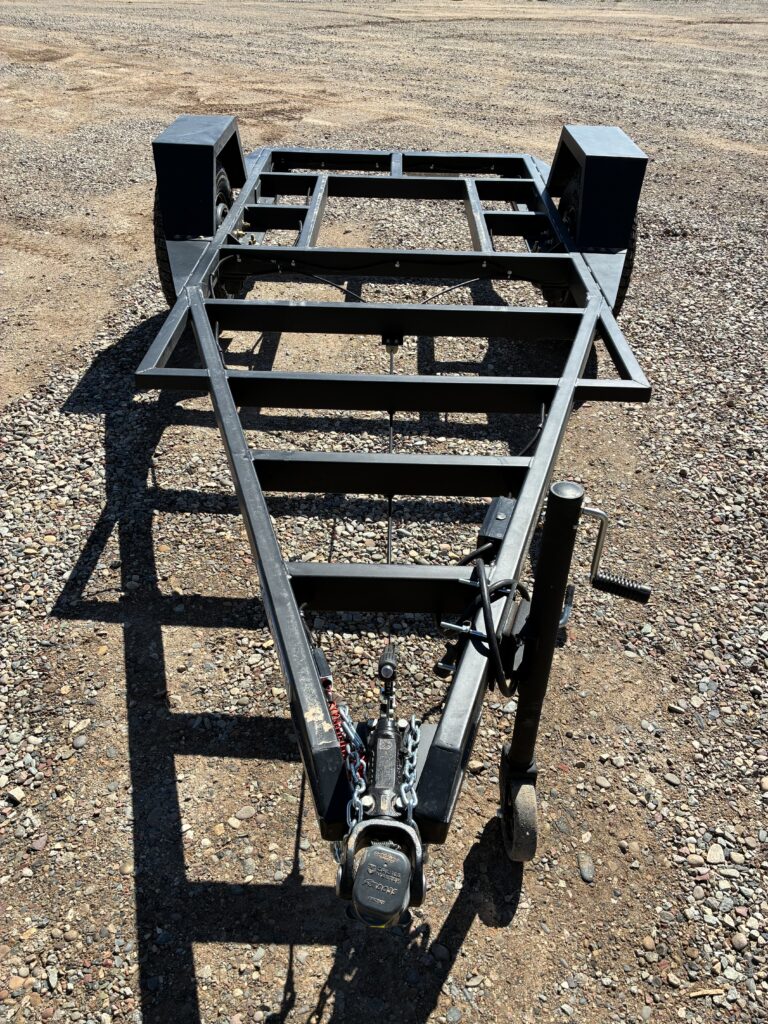
If there’s one thing the overlanding community undervalues, it’s the frame. Most people obsess over the floor plan, the fridge brand, the solar setup. The chassis is an afterthought, until it cracks at mile marker 200 on a boulder field with no cell signal. We know, we’ve been here, trail welding an axle. Not fun.
A chassis built for real off-road use starts with steel tube construction, not stamped channel iron. Tube steel distributes torsional stress across the entire cross-section of the tube. Channel iron, the I-beam style frame you’ll find on most production off-road camping trailers, has inherent stress concentration points at the corners of the channel. Put enough flex into it on rough terrain and it cracks, usually at welds, always at the worst possible time.
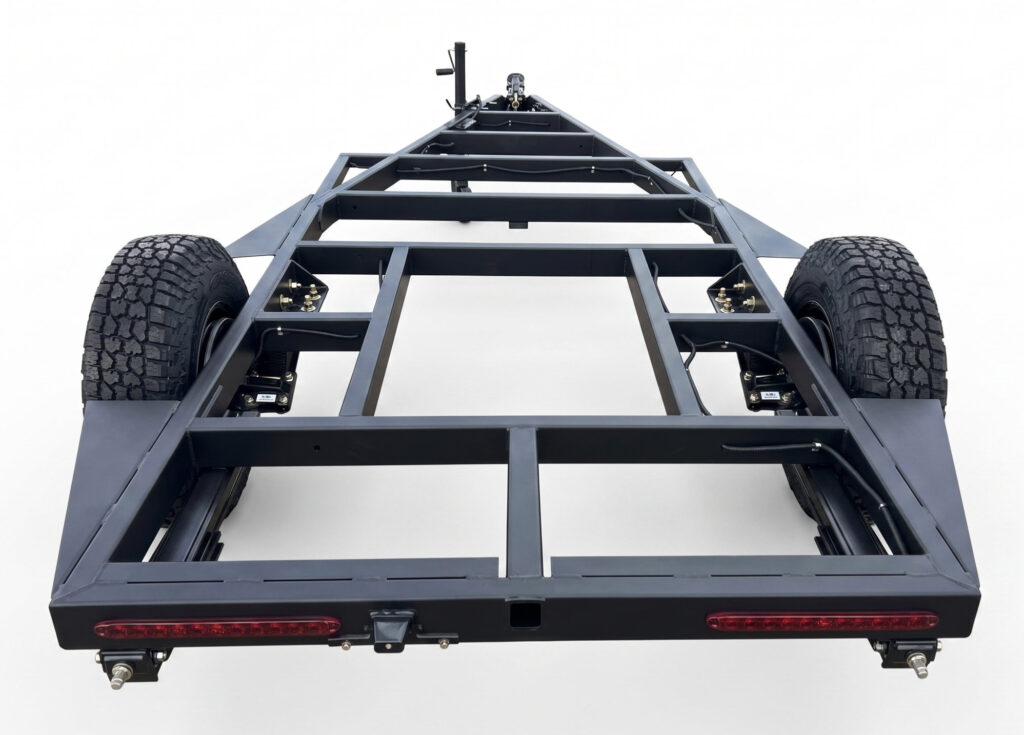
The ROCH Chassis runs CNC-cut 4″ × 2″ × 1/8″ tube steel with an industrial powder-coated finish. The CNC cut matters, it’s not hand-ground and welded by whoever’s on shift. Every joint is precision-cut for a tight, repeatable fit before it’s welded. The anti-corrosion powder coat isn’t decorative, it’s a functional armor layer against the salt, mud, and moisture that destroy frames from the inside out over years of use.
ROCH Chassis — Frame Spec
4″ × 2″ × 1/8″ Tube Steel
CNC-cut for precision fit · Industrial powder-coat anti-corrosion finish · 3,500 lb GVWR · 2,620 lb payload on the bare chassis
The powder coat on a trailer frame isn’t optional if you’re doing this long-term. Bare steel trailers rust. Painted trailers rust where the paint chips, which is everywhere after a season of use. Industrial powder coat bonds into the steel surface at a molecular level and won’t flake off when a rock tags the frame at 45 mph. It’s the difference between a trailer that looks like hell in year three and one that still looks solid in year ten.
Suspension: Why Axle-Less Changes Everything
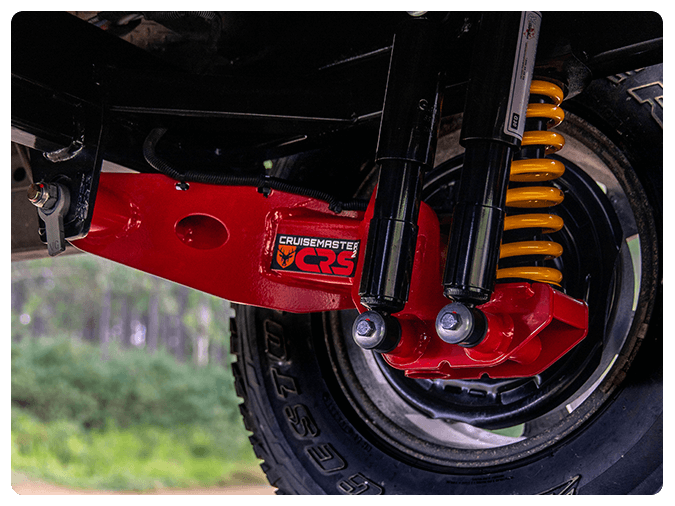
This is probably the single biggest performance gap between a real off-road camping trailer and a standard tow-behind travel trailer. A conventional axle-beam suspension connects both wheels on the same rigid bar. When your right wheel drops into a hole, the left wheel lifts, and if the trailer’s loaded, you’re going to feel every bit of that transfer through the hitch. Worse, conventional axle beams limit articulation. You’ve got a hard cap on how far each wheel can drop before the geometry runs out.
Axle-less independent suspension solves this entirely. Each wheel moves independently on its own torsion bar. The right wheel can drop 12 inches while the left barely moves. The trailer body stays planted. The hitch stays level. And the stress on your tow vehicle’s hitch receiver drops dramatically because the trailer is absorbing the terrain instead of transferring it.
The ROCH runs Cruisemaster CRS2 axle-less independent suspension, a 3,500 lb rated system, with electric drum brakes. It is built specifically for heavy-load overland use. The CRS semi-off-road suspension system quickly became the preferred system for those looking for the quality ride characteristics of an independent arm suspension in a lighter weight package.
Cruisemaster is an Australian brand with a long track record in the outback, where the terrain makes most U.S. off-road use look like a Sunday drive. The system requires no lubrication, no adjustment, and no greasing at regular intervals. Fewer maintenance touch points means fewer failure modes in the field.
“The suspension is what separates a trailer that handles the backcountry from one that leaves you stranded on the side of the road.”
The practical upside on trail: your tow vehicle handles more predictably because the trailer isn’t constantly trying to push or pull the hitch. Your cargo stays stable because the body isn’t bouncing in sync with every obstacle. And long-term, your off-road camping trailer survives because the frame isn’t being flexed and racked every time one wheel hits a rock.
The Coupler: Your Trailer’s Connection to Reality
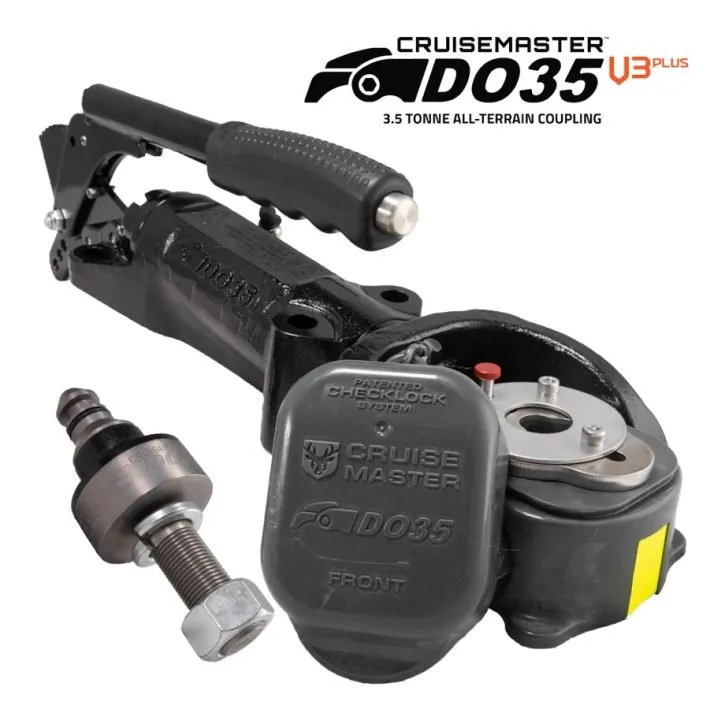
A standard ball-and-socket coupler is fine for a campground trailer. It’s not fine for technical off-road terrain. On steep descents, tight switchbacks, and uneven surfaces, you need hitch articulation in more than one plane. A standard coupler binds. It loads up stress into the ball mount, the hitch ball, and the frame neck. Add a trailer with any weight in it and that binding creates moment loads that will fatigue metal over time.
The ROCH uses the Cruisemaster D035 multi-axis hitch, a purpose-built overland coupler that allows pitch, roll, and yaw articulation independently. This means the trailer can lean side to side and pitch nose-up or nose-down without fighting the tow vehicle’s receiver. The D035 also includes a parking brake, which matters more than people think. If a hydraulic coupler-brake fails or you’re on a slope, an integrated parking brake is the difference between a secured trailer and a runaway.
The multi-axis design isn’t a luxury, it’s a functional requirement for any trailer doing genuine 4×4 terrain. Standard couplers are simply not engineered for the articulation demands of off-camber terrain, water crossings, and steep technical climbs.
Ground Clearance: The Number That Determines Where You Can Go
Your tow vehicle might clear a ledge. Your trailer might not. Ground clearance on a trailer is often the binding constraint on where you can actually go and most production trailers are built with around 10–12 inches of clearance. That’s enough for gravel roads and average two-tracks. It’s not enough for technical rocky terrain.
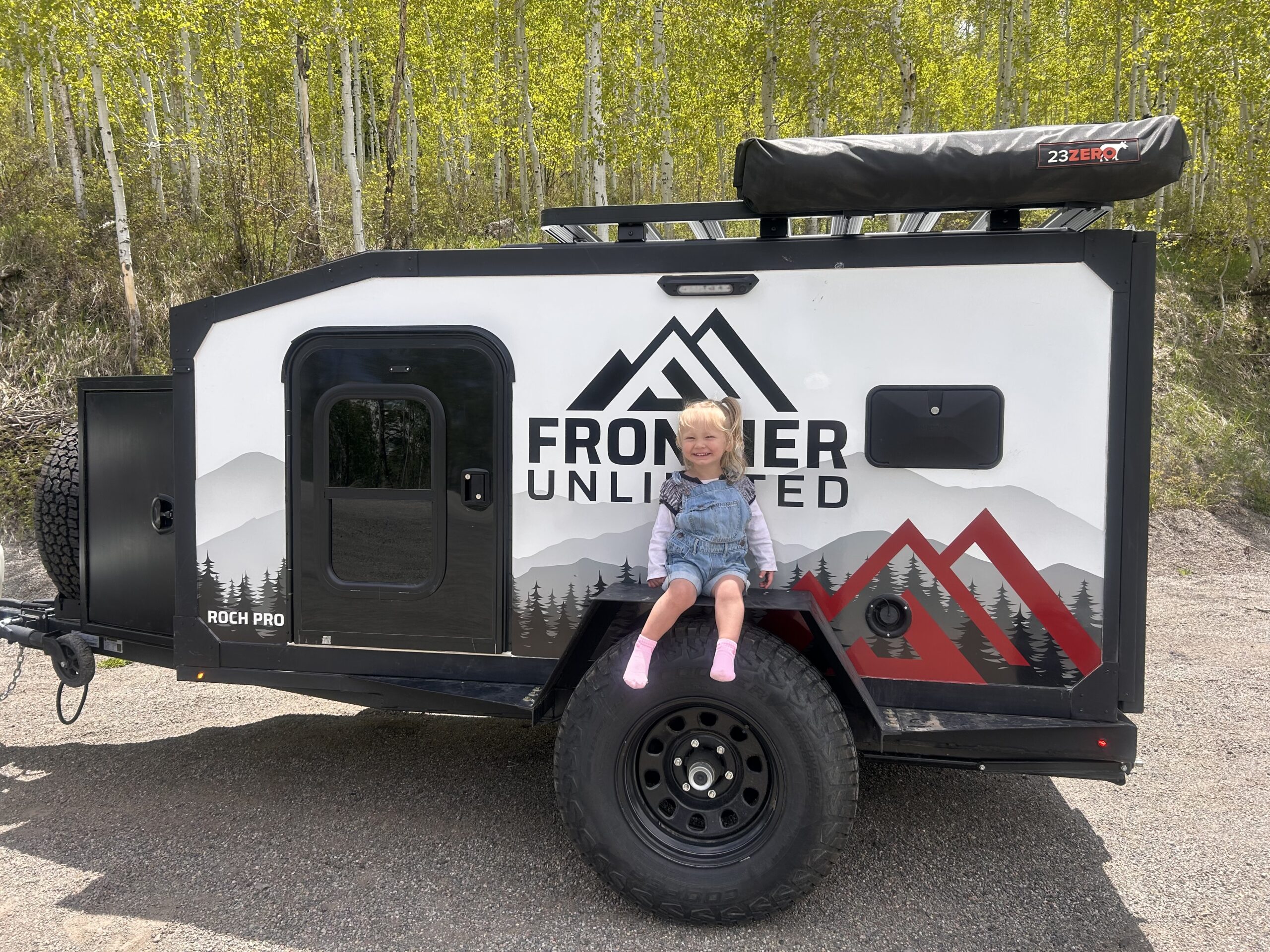
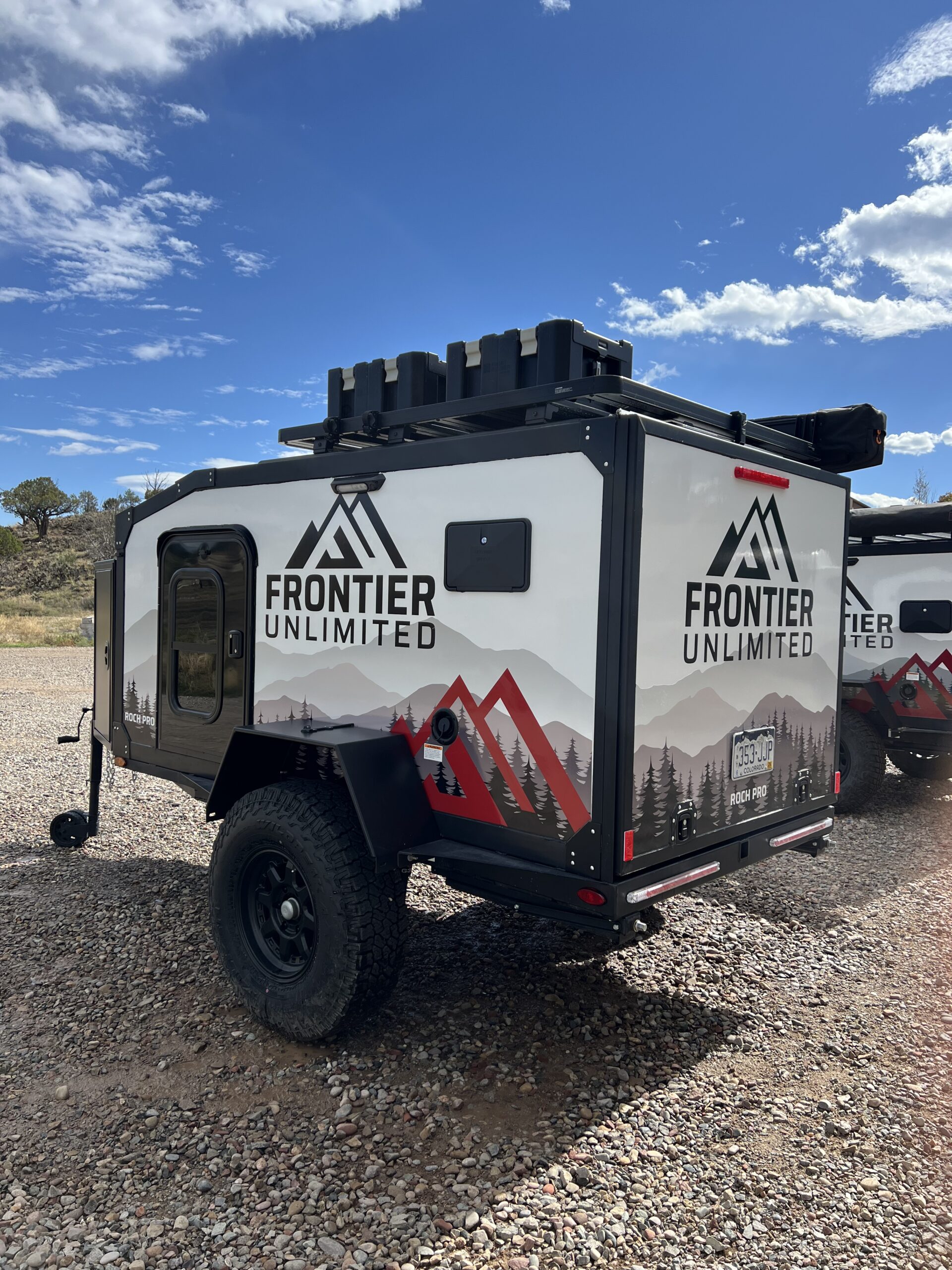
The ROCH Chassis sits at 21.5″ of ground clearance. The fully-built ROCH Pro runs 18″ under the body, with a 22″ hitch height. The 18″ body clearance isn’t a coincidence, it’s the result of the axle-less suspension geometry combined with deliberate ride height engineering. The aluminum skid plate covering the water tank is an additional layer — when you do catch a rock, the tank doesn’t, and the skid plate is replaceable.
ROCH Chassis Ground Clearance
21.5 Inches
Bare chassis · ROCH Pro body clearance: 18″ · Hitch height: 22″ · Aluminum skid plate protects water tank
The reason hitch height matters as much as body clearance: on a steep approach angle, the tongue of the trailer will drag before the body does. A 22″ hitch height gives you the entry angle to climb ledges and drop into steep descents without the trailer nose catching terrain. If you’ve ever watched a low-hitch trailer jackknife its tongue into a ledge, you understand exactly why this number matters.
Brakes: The Feature Most People Don’t Think About Until They Need It
Trailers with no brakes or undersized brakes are one of the leading causes of overland accidents. Add a loaded trailer to any significant downhill and your tow vehicle’s brakes alone are fighting the weight of both vehicles. On a loose or wet surface, that’s how runaway trailers happen.
The ROCH runs 12″ electric drum brakes, controller-synced to your tow vehicle’s brake controller. When you apply the brakes, the trailer brakes proportionally. On downhills, you can enable trailer brake priority to let the trailer do most of the work and take the heat load off your tow vehicle’s rotors.
Electric drum brakes are the right call for off-road use for a few reasons. They’re sealed against mud and water in ways that disc setups on budget trailers aren’t. They don’t fade as quickly under sustained low-speed braking (like a long mountain descent) as smaller brake formats. And they’re serviceable in the field — brake shoes are a simple replacement that anyone with basic mechanical skills can handle at a campsite if needed.
Recovery Points: Because You Will Get Stuck
In the overlanding world, it’s not “if you get stuck,” it’s “when and how badly.” A trailer without integrated recovery points is a problem waiting to happen. Rigging a strap around a frame rail or tow ball is how you damage equipment, or worse, create a projectile when something fails under load.
The ROCH has a multi-function 2″ rear receiver hitch integrated into the chassis. This is not an afterthought bolt-on. The rear receiver is structurally integrated into the frame design, which means it can take pull loads in recovery scenarios without flexing the frame. It also functions as a standard receiver for a spare tire carrier, a hi-lift jack mount, a camp table, a bike rack, or any other 2″ receiver accessory in your kit.
Having a rear receiver on your off-road camping trailer also means you have a recovery anchor point at the back of your rig, useful when you need to winch the trailer out separately from the tow vehicle on particularly technical terrain.
Tires and Wheels: Don’t Overlook the Only Things Touching the Ground
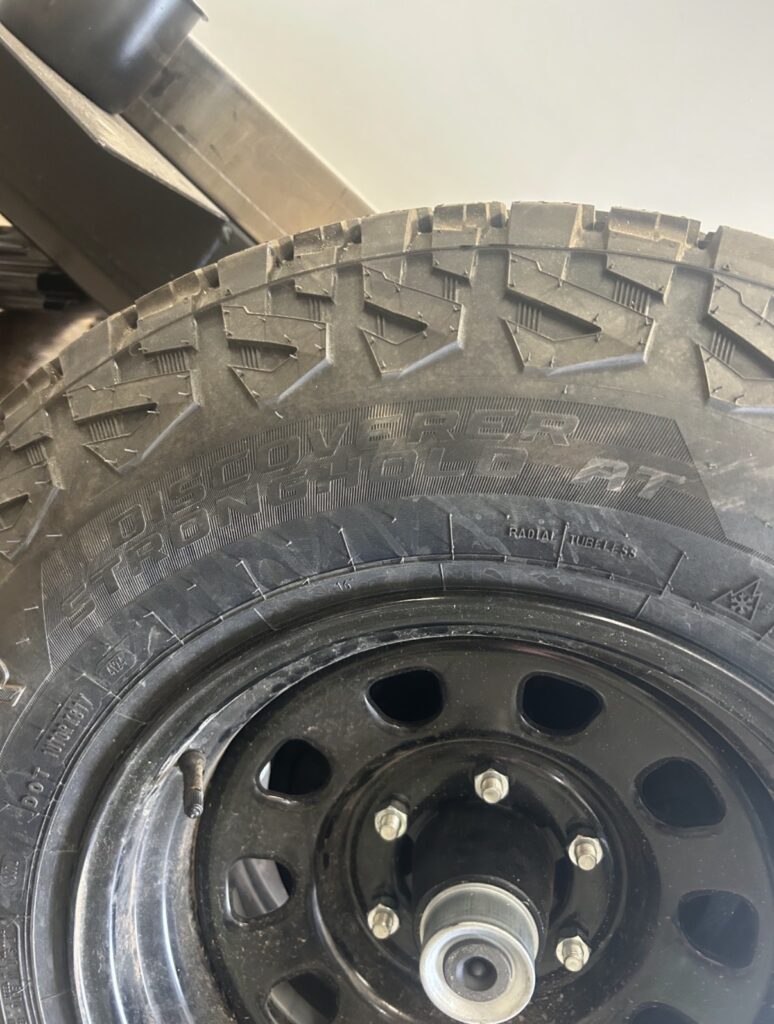
Trailer tires are often a cost-cutting area for manufacturers. ST (Special Trailer) tires are cheaper, but they’re not designed for the lateral stress of off-camber terrain and cornering loads. They run hotter, they’re more prone to blowouts under load, and they have lower speed ratings than LT (Light Truck) tires.
The ROCH rolls on 235/85R16 Cooper Discoverer A/T tires, a proper LT all-terrain tire in a 31.7″ × 9.3″ footprint, mounted on 16″ black steel wheels with a 6×5.5 bolt pattern. That bolt pattern is shared with most Toyota, GM, and Nissan 4×4 platforms, which means in a genuine emergency, you can swap a spare from your tow vehicle to the trailer or vice versa.
- LT-rated tires handle lateral and off-camber loads better than ST trailer tires
- A/T tread pattern gives traction in mud, sand, and loose rock — not just pavement
- 31.7″ diameter contributes to ground clearance and obstacle roll-over
- Steel wheels take rock strikes that would crack alloys
- Full-size matching spare — not a donut, not a smaller spare, same tire and wheel
- 6×5.5 pattern cross-compatibility with most popular 4×4 tow vehicles
That full-size matching spare deserves extra emphasis. A donut spare on a trailer you’re running 50 miles from civilization is cute, but not a functional spare. The ROCH carries a complete matching spare because when a tire fails on trail, you need to be able to continue, not crawl out at 20 mph.
Shell Construction: Why Material Choice Matters More Than It Looks
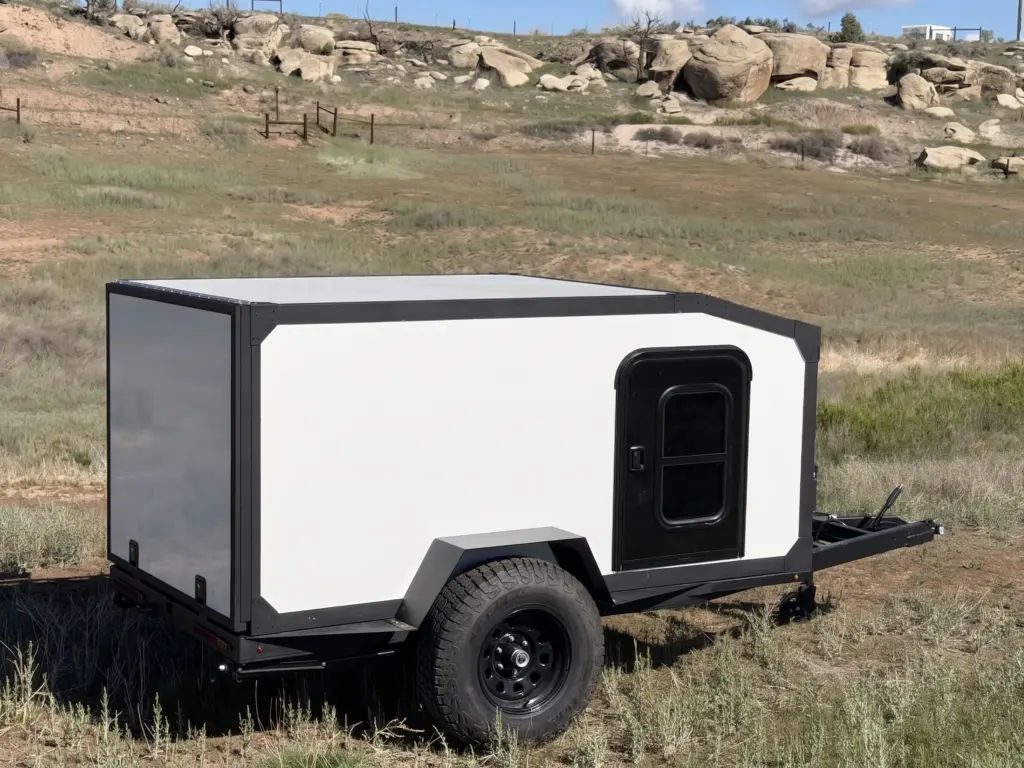
Traditional RV construction uses a wood-framed shell with aluminum skin. It’s cheap, easy to build, and fine if your trailer never gets wet, never flexes significantly, and lives in a climate-controlled storage facility. For off-road use, it’s a liability. Wood frames absorb moisture and rot. The connection points between wood framing and aluminum skin loosen under vibration. Delamination, where the wall layers separate from each other, is endemic in wood-framed RV construction.
The ROCH Pro shell is impact-resistant composite with a powder-coated CNC-cut aluminum exoskeleton. The composite shell doesn’t absorb moisture. It doesn’t rot. It doesn’t delaminate. It takes impacts that would crack or dent a traditional aluminum-skinned wall. The aluminum exoskeleton adds structural rigidity, the kind of rigidity that keeps the shell from racking when you’re going through a series of opposing ruts that twist the whole rig.
The insulation rating matters more than most people anticipate when building for long-term use. The ROCH Pro’s R-9 rated 2″ fully insulated cabin is what makes four-season capability genuine rather than theoretical. R-9 keeps a 12,000 BTU furnace from running constantly in cold weather and keeps the interior from becoming an oven in direct summer sun. If you’re spending multiple nights above 8,000 feet in October, which every mountain dweller knows is entirely possible at any time from September through June, that insulation rating is not optional.
Power and Off-Grid Systems: Energy Independence Is Not a Luxury
Running out of power in the backcountry isn’t an inconvenience, it’s a safety issue. If your refrigerator dies, your food goes. If your lights die, you’re navigating a camp in the dark. If your communication devices die, you’re truly isolated. A serious off-grid power system is a core reliability feature, not a luxury upgrade.
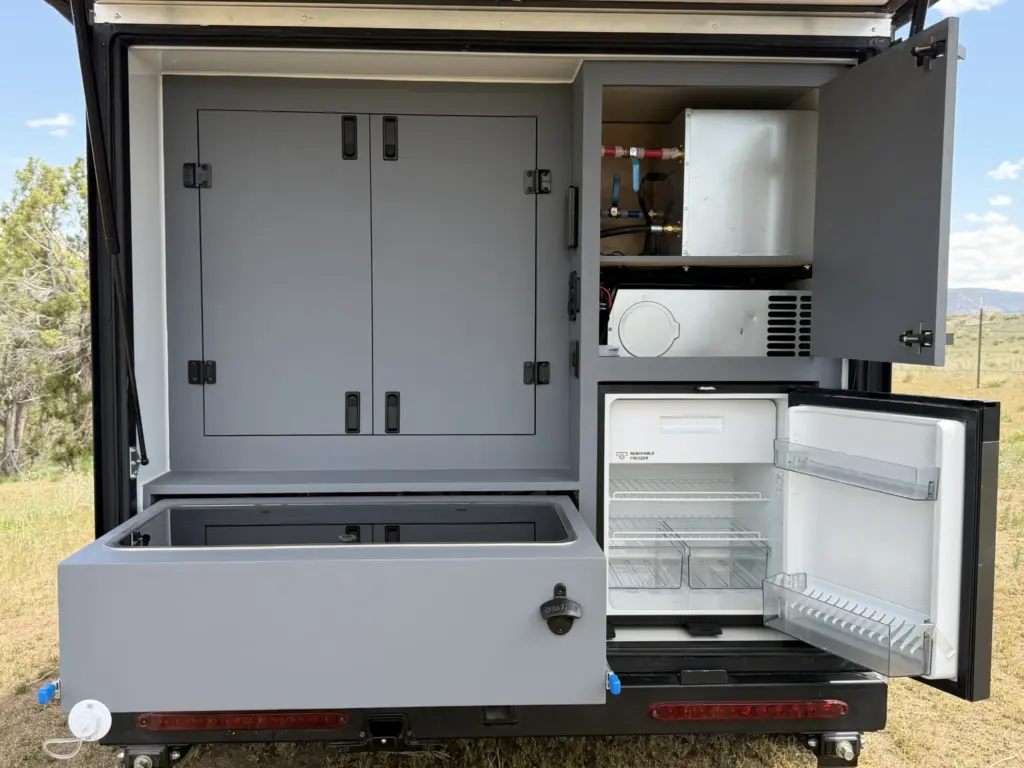
The ROCH Pro runs a 200Ah LiFePO4 smart lithium system anchored by two 100Ah GoPower batteries. Lithium iron phosphate chemistry is the right call for mobile applications for several reasons:
- LiFePO4 delivers usable capacity down to about 20% state of charge whereas lead-acid gives up at 50%, meaning you only get half the rated capacity
- Lithium doesn’t degrade from partial charging cycles the way lead-acid does — you can top off when you have power without harming the battery
- Cold weather performance is dramatically better than AGM or flooded lead-acid
- Weight savings, 200Ah of lithium weighs roughly half what 200Ah of quality AGM weighs
- The smart BMS (battery management system) provides real-time monitoring and protects against over-discharge, over-charge, and temperature extremes
The charging architecture matters as much as the battery capacity. The ROCH Pro uses a triple-input charging system: 110W Obsidian solar with a portable expansion plug (so you can add panels as needed), a high-speed vehicle alternator charger that recovers battery while you drive, and 15-amp shore power when you’re near a hookup. The 2000W pure sine inverter handles anything you’d plug into a standard wall outlet — actual sine wave, not modified sine, which matters for sensitive electronics like camera batteries, laptop chargers, and CPAP machines.
The Power-trak 3″ digital display gives you real-time visibility into state of charge, input wattage from solar, draw rate, and estimated time remaining. You can make intelligent decisions about your power consumption instead of guessing and hoping.
RVIA Certification: Why “Built to Standards” Actually Matters
The off-road trailer market is full of small builders, custom shops, and garage operations. Some of them build excellent products. Many of them build trailers with no formal safety inspection process, no electrical standards compliance, and no independent structural review. When something goes wrong with an uncertified trailer, you’re on your own, legally and practically.
Frontier Unlimited is a proud RVIA member manufacturer, which means the ROCH lineup is built to RVIA safety and construction standards. RVIA certification covers electrical systems, LP gas systems, structural integrity, and fire safety, including smoke detectors, CO detectors, propane leak detectors, and fire extinguisher requirements that are actually integrated into the build, not bolted on as afterthoughts.
For long-term off-road use, RVIA compliance means your trailer’s electrical system isn’t going to create a fire hazard, your LP system won’t leak, and the structural build meets minimum standards that have been audited by someone other than the manufacturer. It’s not a guarantee of quality, but it’s a meaningful floor, and it matters if you ever need to make an insurance claim or if you’re bringing your rig across borders.
—The Bottom Line
Reliable off-road trailer performance isn’t one feature — it’s a system. A great suspension on a weak frame is still a weak trailer. Great tires on a trailer with no brakes are tires that aren’t helping you stop. A well-insulated shell on a trailer with a mediocre power system means you’re cold-soaking your batteries in October and wondering why they don’t last.
The ROCH lineup was built by people who’ve broken every part of this system at some point in 100,000+ miles of travel, and who refused to build a product that repeated any of those failures. It took four years of R&D, real-world testing in the real backcountry, and a commitment to not shipping trailers until the engineering was actually right.
If you’re building a long-term overlanding setup and you want to know exactly what features matter and why, you now have the full picture. If you want to see all of it spec’d out in a single rig, the ROCH Pro is it. Built in Silt, Colorado. Veteran-owned. No compromises.Truly Unstoppable.
Common Questions About Off-Road Trailer Reliability
Axle-less independent suspension means each wheel on the trailer moves on its own torsion arm, completely independent of the other side. When your right wheel drops into a hole, the left wheel stays planted. The trailer body stays level. The hitch stays calm.
On a conventional axle-beam trailer, both wheels are bolted to the same rigid bar. When one drops, the other lifts — and the whole chassis flexes. That flex transfers directly into your hitch receiver, your tow vehicle’s frame, and eventually into your trailer’s welds.
For serious off-road use, axle-less independent suspension isn’t an upgrade — it’s a requirement. The ROCH Chassis uses Cruisemaster HD independent suspension rated to 3,500 lbs, with no lubrication or regular adjustment needed. Fewer maintenance points mean fewer failures in the field.
Tube steel, not channel iron. When your trailer flexes on rough terrain, tube steel distributes torsional stress across the full wall of the tube. Channel iron — the I-beam style frame used on most production trailers — concentrates stress at the interior corners. That’s where cracks start, always at welds, usually at the worst possible time.
The ROCH Chassis runs CNC-cut 4″ × 2″ × 1/8″ tube steel. CNC means every joint is precision-cut for a tight fit before it’s welded — consistently stronger than hand-ground fabrication.
Add an industrial powder-coat anti-corrosion finish that bonds to the steel at a molecular level — not paint that chips every time a rock tags the frame — and you have a chassis that looks solid in year ten, not just year one.
For gravel roads and mild two-tracks: 10–12 inches is passable. For genuine backcountry and technical terrain — you want 15+ inches under the body and a hitch height of at least 17–19 inches.
The hitch height is the number people always overlook. On a steep approach angle, the trailer’s tongue hits terrain before the body does. A low hitch means you’re digging the nose into a ledge while your tow vehicle’s bumper is still clearing it.
The ROCH Chassis sits at 18.5″ of clearance on the bare frame. The fully-built ROCH Pro runs 15″ of body clearance with a 19″ hitch height — plus an aluminum skid plate on the water tank so when you catch a rock, it’s the skid plate taking it, not the tank.
Yes — both legally and practically. Most states require brakes on any trailer over 1,500 lbs loaded. More importantly: on mountain descents, your tow vehicle’s brakes alone are fighting the combined weight and momentum of both vehicles. That’s how brake fade happens. That’s how runaway trailers happen.
Electric drum brakes synced to a brake controller are the right call for off-road use. They’re sealed against mud and water, handle sustained braking on long descents without fading, and are serviceable in the field if needed.
The ROCH runs 12″ electric drum brakes. On steep downhills you can run trailer brake priority through your controller and let the trailer do the heavy work, keeping heat load off your tow vehicle’s rotors.
A standard ball-and-socket coupler gives you one plane of rotation. That’s fine for pavement. Put it on technical terrain — off-camber surfaces, steep switchbacks, uneven rocky ground — and it binds. When it binds under load, that stress goes somewhere: into the ball mount, the hitch ball, the tongue of the trailer. Over time, that’s fatigue cracking in metal you can’t see until something fails.
The Cruisemaster D035 is a multi-axis coupler — pitch, roll, and yaw articulate independently. The trailer moves with the terrain instead of fighting the tow vehicle.
It also includes an integrated parking brake — critical when you’re unhitching on uneven ground, or if a hydraulic brake actuator ever fails. One less thing to rig up separately.
LiFePO4 (lithium iron phosphate). Not because it’s trendy — because the chemistry is genuinely better for mobile off-grid use in every dimension that matters.
Lead-acid and AGM batteries are functionally depleted at 50% state of charge. LiFePO4 gives you usable power down to about 20% — meaning a 200Ah lithium bank delivers roughly what a 400Ah lead-acid bank does in real-world use. Lithium also handles cold weather dramatically better and weighs about half as much for the same capacity.
The ROCH Pro runs 200Ah LiFePO4 with a triple-input charging system: 110W solar with expansion port, a high-speed alternator charger, and 15-amp shore power. The 2,000W pure sine inverter handles sensitive electronics — laptops, camera batteries, CPAP machines — without the issues a modified sine wave creates.
RVIA (Recreation Vehicle Industry Association) certification means the manufacturer builds to audited safety and construction standards — electrical systems, LP gas, structural integrity, fire safety. The key word is “audited” — by someone other than the manufacturer.
In practical terms: your electrical system was built to reduce fire risk, your LP system meets leak-prevention specs, and your smoke detector, CO detector, and propane alarm were designed into the build — not zip-tied in at the end.
For long-term use it matters for insurance claims, border crossings into Mexico and Canada, and as a baseline quality signal in a market full of uncertified garage shops. Frontier Unlimited is a proud RVIA member manufacturer.
Ready to Build Your ROCH?
Configure your ROCH Pro, Base, or Shell — or explore the bare chassis for a custom build.Explore the ROCH Lineup
Leave a Reply