

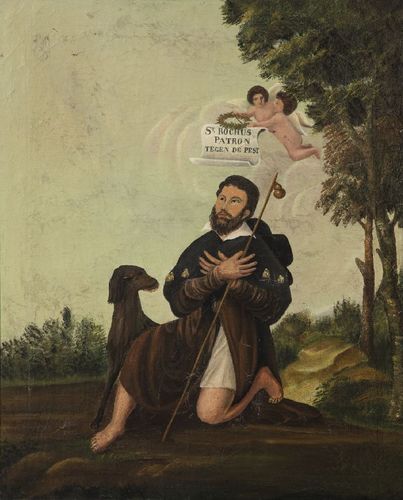
Within the city limits of Montpellier, France settled a wealthy couple who had the world at their fingertips. They could have had anything they’d ever dreamed of. Anything but a child, that is, given the governor and his wife were barren.
But after persevering in prayer and turning to the Blessed Virgin Mary with their full hearts desperately yearning for a little baby to give all their love, John’s wife, Libera, discovered she was with child. At last, she was pregnant. After all these years of loneliness and hope.
In 1295, St. Roch de Montpellier was born with a red cross shaped birthmark woven into the center of his chest, symbolizing his future of devoting himself to the service of others. As his mother stared down at the little infant in her arms, she could not have begun to imagine the amazing things her son would do with his short life.
When St. Roch was still young, his father, John, fell gravely ill. Sensing his approach to death, John called St. Roch to his side, and he entrusted him with four solemn responsibilities; to serve God diligently; to care for the poor, widows and orphans; to manage the family’s wealth for charitable purposes; and to minister to the sick in the hospitals.
St. Roch vowed to keep these wishes. After his father’s death, he buried him with honor. And when he was nearly 20 years old, he mourned the loss of his mother as well, finding himself to be an adult orphan, alone in this world with nothing but the memory of his parents as well as the inheritance, they’d left behind which he renounced, true to his father’s wishes.
He sold his inherited property and he distributed all the money amongst the poor and sick and entrusted the governance of the city to his uncle. Devoting his life to serving God, St. Roch joined the Third Order of St. Francis.
He embraced the life of a mendicant pilgrim. He began traveling, on foot all the way to Italy. Some could claim he was one of the first overlanders, though his journey was more for charitable purposes rather than adventure and wanderlust. His path took him on rough and plaque-ridden lands.
When he arrived in Acquapendente, he discovered a city suffering from an epidemic, the bubonic plaque, also known as the Black Death. This disease swept across Europe, killing millions in the fourteenth century, during St. Roch’s journey.
Despite his fear for his own life, he went to the hospital of St. John and offered his services to the brethren, as well as going to individual homes and tending the sick there. He served them without any rest for himself. By day and by night, he gave them his all.
He miraculously did not catch the disease himself and through him, God performed miracles, healing many by the mere sign of the cross which St. Roch made over them.
When the plague ended, St. Roch continued his venture, hiking over 90 miles to Rome, stopping at other Italian cities on the way, giving of himself and serving people as he went. In Rome, another epidemic had broken out. He performed the same services in many other towns of Italy before he arrived in Pacenza.
Although, eventually, St. Roch fell sick himself. Battered down by the dreadful disease, he went to the very hospital he had cured and tended to so many of the ill. But now he was looked down on, people viewed him as an intruder, someone with no right to claim a place in one of the hospital beds, despite all the sacrifices he’d made, the endless acts of service and the deep devotion and care in his heart for others. It was not going to be recompensed. However, that was never his reasoning for his service at any rate.
Therefore, with a desire to not be a burden to others, he departed from the hospital. He ventured into the woods. When he stumbled upon a damaged hut, he lay down and thanked God for the quiet lodging. St. Roch was prepared to die there, alone in the forest surrounded by trees with nothing but the lesion in his leg.
It was there that he was unexpectedly befriended by a nobleman’s hunting dog who providentially discovered him one day. The dog provided him with bread and other scraps of food stolen from its masters table. They bonded and the dog licked St. Roch’s wounds, miraculosuly aiding his recovery. Because of the dog’s care and the providence of God, St. Roch eventually recovered from the plaque.
A man’s best friend and, evidently, a man’s hero as well. In his darkest hour, a dog not only brought him food and water, but also offered loyalty, comfort and companionship when people wouldn’t.
Until one day the dog’s master came searching for his missing companion and found it in the forest tending to this holy pilgrim. Grateful, the noblemen took over the task and cared for St. Roch himself until his health was fully restored.
When St. Roch had regained enough of his strength, he found himself inspired to return to his hometown. Again, he embarked on a voyage with nothing but his faith and memories, treading over uneven ground and through valleys and hills.
However, at home there was a furious warfare raging. Immediately, he was judged and seen as an enemy. He was accused of being a spy and was led before the governor of Montpellier, which was a title his uncle still held. However, after all these years, his uncle didn’t recognize him, his long-lost nephew. Instead, he charged St. Roch with the accusations and threw him into prison.
And because of the disturbances of the war, St. Roch was almost completely forgotten and left in prison for five years.
St. Roch didn’t defend himself. He didn’t reveal his true identity, either. Not to his uncle or the guards or the other prisoners. He wished to imitate Christ and to accept in silence whatever Heaven had in store for him. He kept his lineage hidden and was cared for by his guardian angel.
When it became aware to St. Roch that he was nearing his death for the second and final time, he asked that a priest might come and administer the last sacraments to him. The priest, upon entering the cell, found it bathed in divine light, and the poor captive was surrounded with a special radiance.
And then one day in 1327, St. Roch passed away from natural causes in Montpellier, France.
After St. Roch took his final breath; a tablet appeared on the wall with golden letters spelling out the name Roch, and the prediction that all who would invoke his intercession would be delivered from the plague.
After hearing of the miracle, St. Roch’s uncle’s interests were piqued. He went to the prison, bringing with him his mother and St. Roch’s grandmother. She identified the man as her grandson by the birthmark of the red cross on his chest.
They gave him a magnificent funeral and had a church built in his honor, in which his body was entombed. His veneration was approved by several popes and soon spread throughout all of Europe. He was canonized by Pope Gregory XIV.
He is the patron Saint of plague victims, bachelors, travelors, dogs and falsey accused people. His feast day is celebrated on August 16th.
St. Roch is our inspiration for so many reasons, so much so we decided to name our camper after him because of his protectiveness and his rugged independence. His story is one of unwavering devotion and a hint of wanderlust, similar to the hearts of the builders at Frontier Unlimited.
And at the heart of every ROCH camper is a legacy of resilience, protection and companionship, imitating St. Roch.
St. Roch, pray for us.


Leave a Reply