

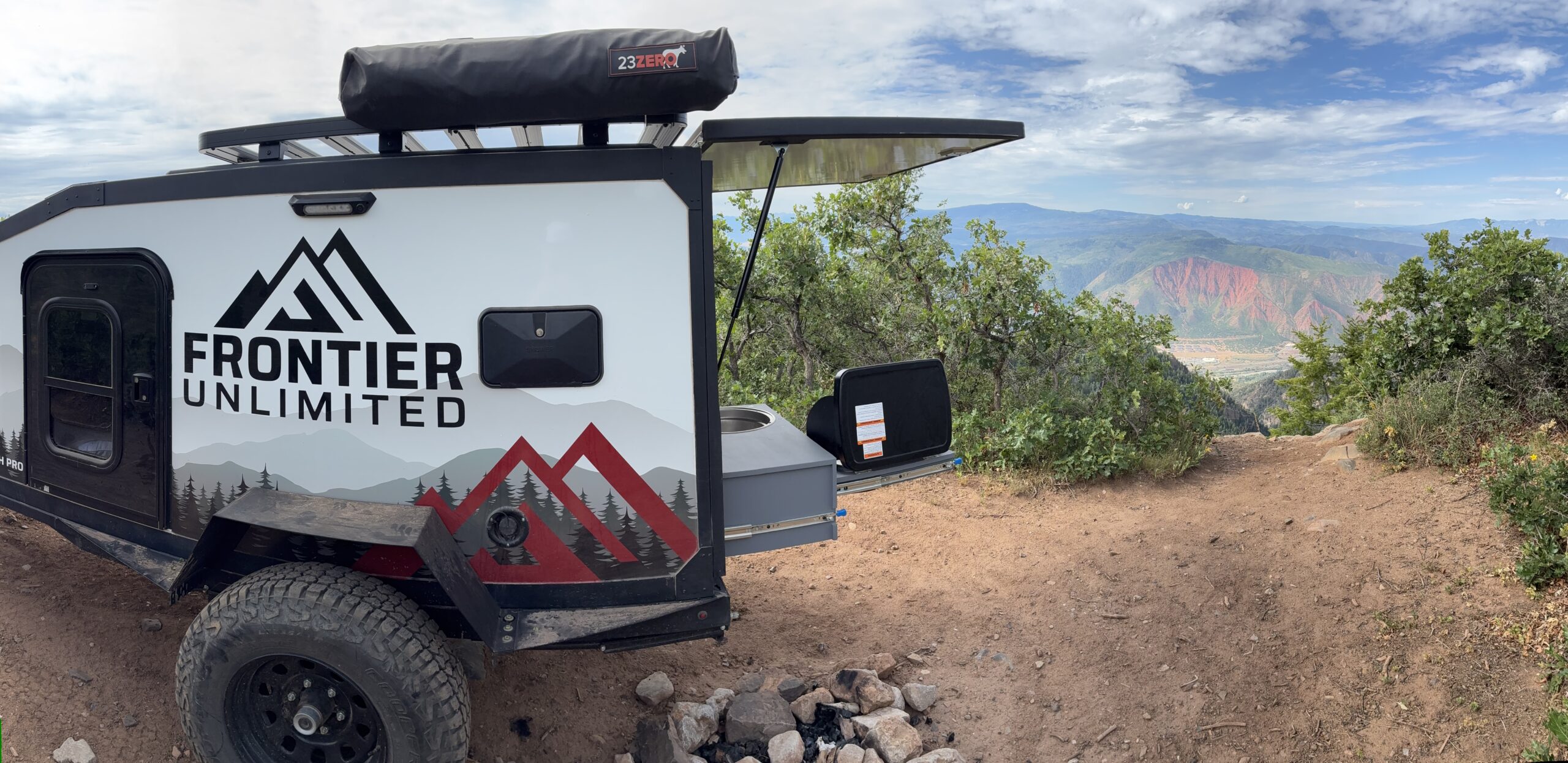
Most people buying a composite panel camper never think to ask what’s inside the walls. They look at the suspension. They check the hitch. They open every cabinet and lay down on the bed. They don’t ask what the walls are made of.
That’s the question that matters most.
Wall construction determines how your camper holds up to moisture, temperature extremes, vibration, and time. Get it right and you have a rig that performs the same on year ten as it did on day one. Get it wrong and you’re dealing with leaks, rot, and delamination before the warranty runs out. In fact, we just helped a customer of another camper company redo his suspension—and the delamination on that very popular brand was insane.
At Frontier Unlimited, we build the ROCH as a wood-free composite panel camper. No wood framing. No aluminum sheeting. No steel walls. There’s a reason for every one of those decisions, and it comes down to science, not preference.
Table of Contents
WOOD: THE STANDARD THAT SHOULDN’T BE
Wood is still the most common wall framing material in the trailer industry. It’s cheap, it’s familiar, and it’s easy to work with. It’s also a terrible choice for a camper that actually goes off-road and into the elements.
The problem is fundamental: wood is porous. It absorbs moisture through every joint, every fastener hole, every cut edge. Once water infiltrates, and on a trailer used in the real world, it will, the damage begins. Wood swells, warps, and eventually rots. Fasteners loosen as the material around them degrades. The wall skin separates from the frame in a process called delamination, and what was once a rigid panel becomes structurally compromised.
“By the time you see the damage, you’re already deep into a repair or a replacement.”
Wood is also a poor insulator relative to its weight. Wood-framed walls create thermal bridges—direct conductive pathways for heat and cold to move through the wall. That means inconsistent interior temperatures, condensation forming inside the wall cavity, and higher energy demand from your heating and cooling systems. None of that belongs in a composite panel camper trailer built for real off-grid use.
The weight penalty is real too. Wood is heavy for what it contributes structurally in a wall panel application. Every unnecessary pound is tongue weight, tow vehicle stress, and lost payload.
Wood was the best option available decades ago. There’s no engineering reason to keep using it.
STEEL WALLS: STRONG IN THEORY, WRONG IN PRACTICE
Steel is undeniably strong. In the right application, it’s the correct material. Our chassis is CNC-cut steel because for a load-bearing, weldable structural frame that takes the full force of rough terrain, nothing beats it.
But steel walls are a different conversation. Steel is roughly three times heavier than aluminum by volume and significantly heavier than composite panels. In a wall system, that weight adds up fast and comes straight out of your payload capacity.
Steel rusts. Full stop. Coatings help, but they don’t prevent it forever. Every scratch, every weld point, every fastener penetration is the beginning of an oxidation timeline. River crossings, mud, coastal salt air, winter roads—all of it accelerates that process. Maintaining a steel-walled camper in active off-road use is a permanent commitment.
Steel is also an aggressive thermal conductor. In cold environments, steel-framed walls become heat thieves, efficiently moving warmth from inside the camper to outside. You end up heating the landscape. That costs battery power, fuel, and comfort.
For a chassis: steel. For walls: wrong tool.
ALUMINUM: BETTER THAN STEEL, STILL NOT GOOD ENOUGH
Aluminum is where many of the off-road trailer industry has landed. It’s lighter than steel and more corrosion-resistant. On paper, it’s a reasonable choice. Under real off-road conditions, its weaknesses are specific and serious.
FATIGUE CRACKING
Aluminum doesn’t flex under stress but it fatigues. Repeated vibration cycles cause micro-fractures that grow over time. An off-road trailer absorbs thousands of those cycles on a single trip across any terrain, but it does serious damage on rough. Those micro-cracks expand. Fastener holes elongate. Panel joints fail. This isn’t a defect it’s a material property. Aluminum has a finite fatigue life, and off-road use burns through it.
THERMAL BRIDGING
Aluminum conducts heat roughly four times more efficiently than steel. That sounds like a benefit until you understand what it means in a wall system: aluminum framing members are continuously moving temperature from outside to inside (or vice versa), regardless of how much insulation you pack between them. The studs undermine the insulation. You can’t fix it, it’s the material’s properties.
GALVANIC CORROSION
Wherever aluminum contacts a dissimilar metal, steel fasteners, brackets, fittings, galvanic corrosion begins. It’s electrochemical, predictable, and unavoidable without engineering around every single contact point with dielectric isolation. That’s solvable, but it’s complexity and maintenance you simply don’t have with other materials.
WEIGHT
Aluminum is lighter than steel and wood, but heavier than composite panels at equivalent structural performance. In an off-road build where every pound has a consequence, that gap matters.
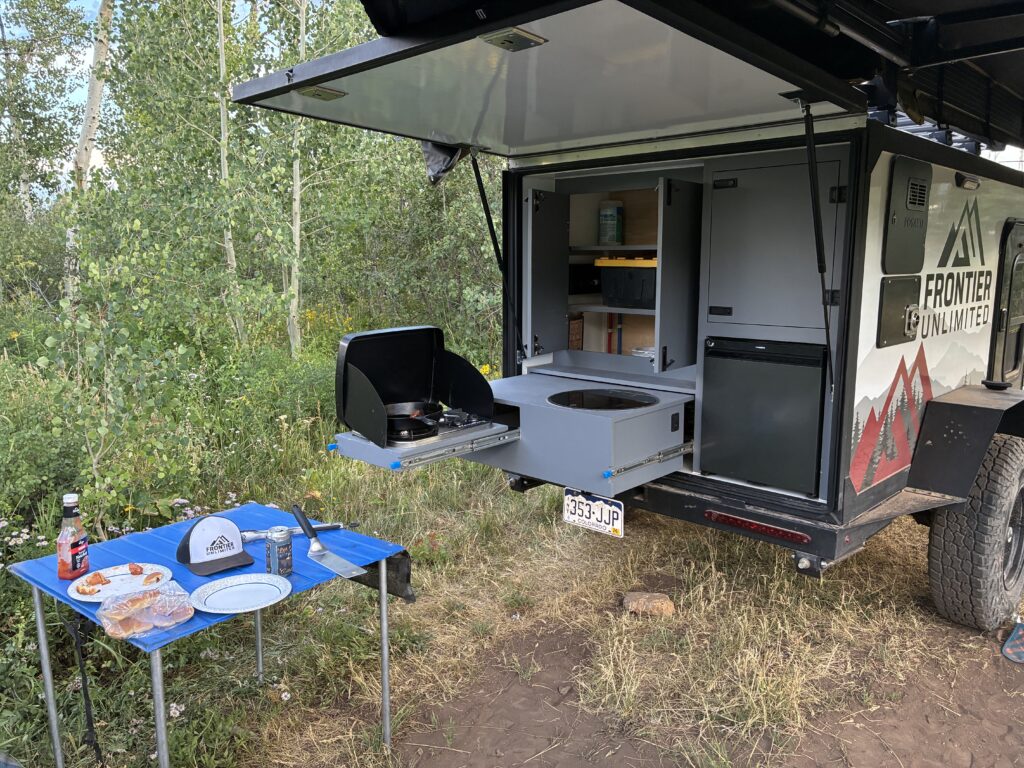
COMPOSITE PANEL CAMPER: THE BEST
A composite panel isn’t a single material, it’s an engineered system. Two rigid face skins bonded to a structural core, built to act as a single unified unit. The result is a panel with properties no individual material can replicate.
STRENGTH WITHOUT THE WEIGHT
Composite panels deliver exceptional strength-to-weight ratios. The bonded construction distributes load across the full panel instead of concentrating it at frame members. That means better impact resistance, better point-load performance, and a wall that functions as a structural element. Composite panel campers are measurably lighter than wood or aluminum-framed equivalents at the same or higher structural performance.
MOISTURE IS A NON-ISSUE
Composite panels don’t absorb water. The core doesn’t rot, swell, or warp. Dimensional stability in wet conditions, high humidity, and freeze-thaw cycling isn’t something we engineer around it’s inherent to the material.
This isn’t a coating or a treatment that degrades. It’s a permanent property.
NO THERMAL BRIDGES
The closed-cell core in composite panels is an excellent insulator, and more importantly, there are no metal studs conducting temperature through the wall at regular intervals. The entire wall performs consistently. Interior temps are more stable, condensation is minimized, and your battery bank isn’t compensating for a leaky wall system.
For a camper used year-round, especially at elevation, like in Colorado, in the desert in July, in the Pacific Northwest in November, that thermal consistency isn’t a luxury. It’s a functional requirement.
VIBRATION RESISTANCE
Composite panels handle vibration differently than metal. Rather than fatiguing and micro-cracking under repeated flex cycles, the bonded construction absorbs and distributes vibration energy across the panel. The structural integrity that exists on day one still exists after thousands of miles of rough road.
LONG-TERM DURABILITY
Composite panels don’t corrode. They don’t rust. They don’t fatigue the way aluminum does. The material that performs on delivery performs the same years down the road. That’s why composite construction is the standard in aerospace, marine, and performance automotive industries that can’t afford material failure.
COMPOSITE PANELS DO NOT FLUCTUATE WITH TEMP CHANGES
Wood moves. Aluminum moves. Steel moves. That’s just what these materials do when temperatures change. Heat them up and they expand. Cool them down and they contract. Run that cycle a few hundred times across a season or two and you’ve got fasteners backing out, seams opening up, and joints that no longer sit where they were built to sit. That’s how leaks start. That’s how rattles start. That’s how a trailer that felt solid when you bought it starts falling apart on the trail. Our composite panels don’t expand or contract with temperature swings. The shell that left our shop is the same shell you’ll have baking in the desert at 105° and parked in the mountains at 20°. No movement. No fluctuation. No structural failure.
“Wood rots. Steel rusts. Aluminum fatigues. Composite panels do none of those things.”
WHAT IT MEANS ON THE TRAIL
A composite panel camper doesn’t need to be managed around its own weaknesses. You’re not mapping around water crossings to protect the walls. You’re not inspecting seams for moisture intrusion after every trip. You’re not planning a re-skin five years in.
The weight savings go directly into capability more battery capacity, more water storage, more gear, better suspension performance, better fuel economy on the tow vehicle.
The thermal performance means your systems work less to maintain the interior environment which extends battery life and reduces the load on your climate equipment.
The structural integrity holds up to the terrain you actually want to drive. Not the terrain you’re willing to drive to protect your investment.
THE BOTTOM LINE
We put years of R&D into the ROCH before we sold one. Material selection was based solely on engineering. We tested the options against the actual demands of off-road use: sustained vibration, moisture infiltration, temperature cycling, weight constraints, and long-term structural integrity.
Composite panels won every time.
That’s why every ROCH, both Base and Pro, is a wood-free composite panel camper. It’s the right way to build an off-road camper that goes into the deep, where you want to go and stays where you want to stay, season after season, year after year.
If you’re shopping for an off-road trailer, we’d love to talk to you about our Roch.
Read about us here, it tells the (long) story of who we are and how we ended up building epic off road campers!
Frontier Unlimited builds the ROCH — a wood-free, composite-panel off-road camper trailer made in the USA. Veteran owned. Family run. RVIA certified. | frontierunlimited.com
Leave a Reply